Disclosure: Crock & Loaf is reader-supported. When you buy through links on our site, we may earn an affiliate commission at no cost to you.
What equipment you actually need to start sourdough
- Skip the all-in-one "starter kits" on Amazon. They are uniformly bad value, with low-quality versions of items you can buy individually for less.
- The essentials, in priority order: a scale, a 1L jar with a wide mouth, a flour you trust, and a flexible spatula. That's it for the first month.
- Add later, when you're committed: banneton, lame, instant-read thermometer, Dutch oven or combo cooker.
- Cost: around $75 for the four essentials at our recommended picks, or about $35 if you substitute a budget scale and a mason jar. The full kit below runs to roughly $200, spread over the first few months.
Why not the pre-built kits?
Search Amazon for "sourdough starter kit" and you will find dozens of bundles between roughly $20 and $50. They typically include a banneton, a lame, a dough scraper, sometimes a dough whisk, sometimes a small jar, sometimes a printed recipe card. They are cheaper than buying our four essentials separately, and they are still the wrong purchase.
The reason is what they leave out. Almost none of them include a scale, which is the one item you genuinely cannot bake good sourdough without. A $30 kit that omits the scale has not saved you $45, it has sold you the optional half of the list.
The problems:
- Items don't match in quality. A decent banneton is included alongside a useless plastic lame and a too-small jar. You pay for the whole bundle to get the one or two usable pieces.
- Wrong priorities. Most kits include a banneton but not a scale. You can bake sourdough without a banneton. You cannot bake sourdough well without a scale.
- Sizes are off. Kit bannetons are usually 8-inch, which is small for the 750g to 1kg dough most home recipes produce. 9-inch is the size you want. Dough scrapers are flimsy. Lames have no replaceable blade.
What follows is what we'd actually recommend buying, in the order we'd buy it.
The most important piece of sourdough equipment: a digital kitchen scale
The single most important piece of equipment for sourdough. Not the most expensive, not the most visible, but the one without which nothing else works. If you measure flour and water in cups, you are introducing variability that compounds at every step. A scale ends that.
What to look for: 1-gram resolution, at least 5kg / 11lb capacity, a tare button you can use to zero out a bowl. That's the whole specification. Anything with those three features will work.
Essential 1 · Scale
OXO Good Grips 11-Pound Stainless Steel Food Scale
The default. Reads in 1-gram increments, has a pull-out display so large bowls do not block the readout, runs on AAA batteries, and survives years of flour spills. Cook's Illustrated recommended. Around $50, lasts a decade. If you only buy one thing from this list, buy this.
Check on Amazon →Essential 2: A 1-liter jar with a wide mouth
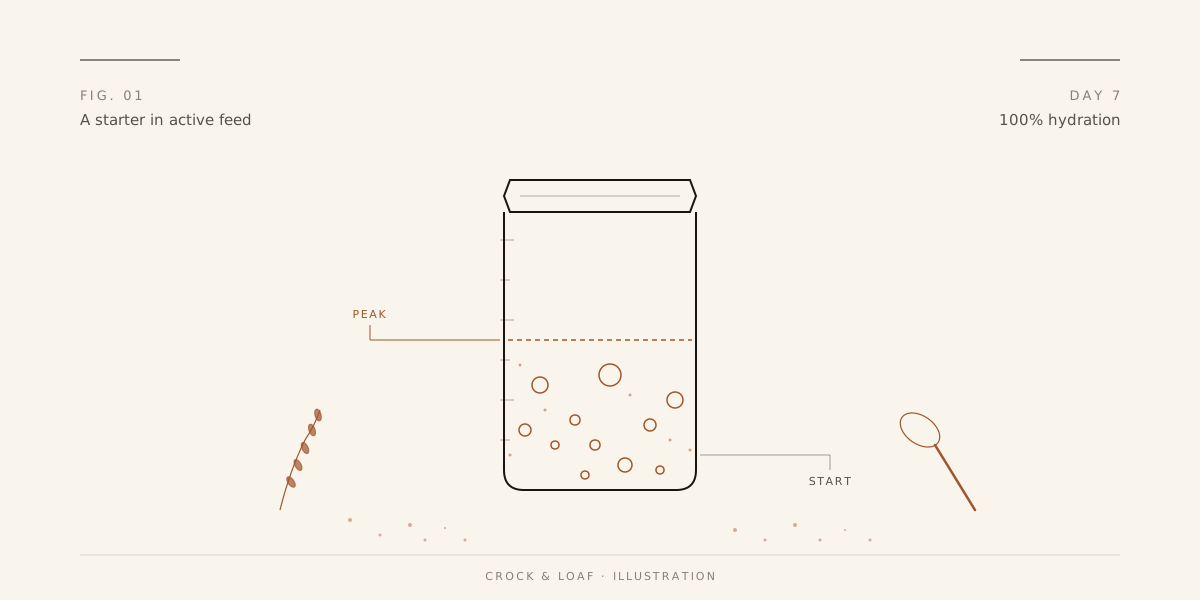
The starter needs a home. Almost any 1-liter glass jar with a wide mouth (wide enough to fit a spatula in) works. The reason wide-mouth matters: you will be scraping the inside walls down dozens of times. A narrow-mouth jar makes that physically annoying for the entire life of the starter.
Get two jars rather than one. Rotating into a clean jar at each feed is the single cheapest defense against mold, which is the one thing that actually ends a starter. Moving a spoonful into a clean vessel is also the first step in reviving a starter that has gone unfed for months.
The classic choice is a Weck tulip jar (the wide-mouth shape with a slight neck). They are not strictly necessary; a quart-sized mason jar with a wide mouth works fine and is cheaper. The key features regardless of brand:
- Wide mouth (3+ inches across).
- Straight sides or only slight taper, so you can see the rise clearly.
- Glass, not plastic.
- 1L / 32oz capacity. Smaller is too cramped; larger is hard to read the rise on small amounts of starter.
Essential 2 · Starter jar
Weck Tulip Jar, 1L (or wide-mouth mason equivalent)
The classic shape. Wide opening, straight sides, glass lid that sits loosely on top (which is what you want; an airtight seal on a fermenting culture is a bad idea). Mason jars work too. Whatever you pick, get two so you can rotate between a clean and a dirty one.
Check on Amazon →Essential 3: Good flour to start the culture
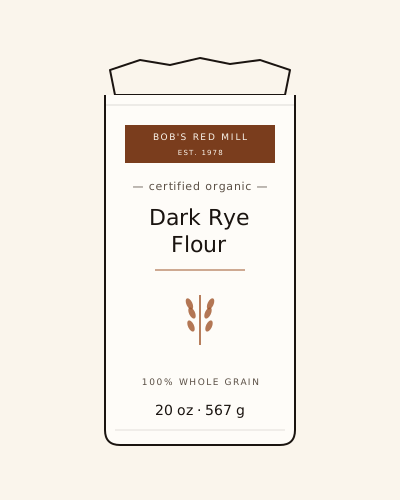
We covered this in detail in our flagship guide to flour for sourdough starters, so we won't repeat the full argument here. The summary: whole-grain rye for the first 7 to 10 days, then transition to whatever you'll be feeding long-term. Bob's Red Mill Dark Rye is the most widely available option in the US.
Essential 3 · Starter flour
Bob's Red Mill Organic Dark Rye Flour
Stone-ground, 100 percent whole grain, no additives. The bran carries the microbial population that gets a new starter going faster than white flour. One 20oz bag is enough to start and maintain a culture for over a month.
Check on Amazon →Essential 4: A Danish dough whisk (or sturdy spatula)
You will be stirring sticky 100-percent-hydration starter and mixing high-hydration doughs by hand. A regular whisk wraps the dough into the wires and becomes useless. A spoon works but slows you down. A Danish dough whisk, a wire shape that sits flat against the bowl, solves the problem.
Alternative: a sturdy flexible silicone spatula. Slightly less efficient but works. You probably already own one.
Essential 4 · Stirring tool
Danish Dough Whisk
The right tool for sourdough mixing. The flat wire shape combines flour and water without trapping dough the way a regular whisk does. Around $10–15. Optional if you have a heavy silicone spatula, but cheap enough to just get.
Check on Amazon →Add later 1: An instant-read thermometer
You can bake sourdough without one. You will bake better sourdough with one. The reason: dough temperature is the most important variable in fermentation, and you cannot judge it by feel. A $20 instant-read thermometer ends the guessing about whether your dough is at 72°F or 78°F, which is a four-hour difference in bulk fermentation time.
The Thermapen is the professional standard and the right answer if you cook other things too (meat, sugar work, oil temperatures). For sourdough specifically, any instant-read in the $20 to $30 range works. The cheap ones are slower (3 to 5 seconds vs the Thermapen's 1 second) but accurate enough.
Add later 1 · Thermometer
Instant-read thermometer (Thermapen or budget equivalent)
A Thermapen ($100) is the gold standard and lasts a lifetime. For just sourdough work, a $20–30 instant-read does the job. Either way, the information about actual dough temperature is what makes the next bake better.
Check on Amazon →Add later 2: A banneton
The cane basket that gives sourdough its characteristic spiral pattern. The dough proofs inside the floured banneton for the final 1 to 4 hours before baking. The cane absorbs moisture from the surface of the dough, which produces a slightly drier skin that takes scoring better.
You do not need a banneton for your first loaves. A bowl lined with a heavily floured cotton tea towel produces a less photogenic but perfectly functional shape. Get a banneton when you're committed enough to want the visual upgrade.
The right size for most home loaves is 9-inch round (for a 750g–1kg dough). The 8-inch is small. The 10-inch is for larger loaves. Round vs oval is preference; round is more versatile.
Add later 2 · Proofing basket
9-inch Round Cane Banneton
The standard home size, and the traditional material. Cane gives the spiral ring pattern people associate with sourdough, though it needs seasoning before dough will release cleanly. Wood pulp bannetons are the practical alternative: America's Test Kitchen found pulp released dough at every hydration with no seasoning at all, where rattan needed breaking in. Choose cane for the pattern, pulp for reliability. Around $20 either way.
Check on Amazon →Add later 3: A lame for scoring
The slash on top of a loaf is not decorative. It controls where the loaf expands during oven spring. Without a score, the loaf bursts unpredictably along the path of least resistance. With a score, you direct the expansion to where you want it.
Most home bakers start with a sharp knife. It works for the first few loaves. The reason to upgrade to a real lame is consistency: a single-edge razor blade held at a slight angle produces a much cleaner cut than a knife.
The most common type is a curved-handle lame with a replaceable razor blade. Cheap, durable, replaceable.
Add later 3 · Scoring tool
Sourdough Lame with Replaceable Blades
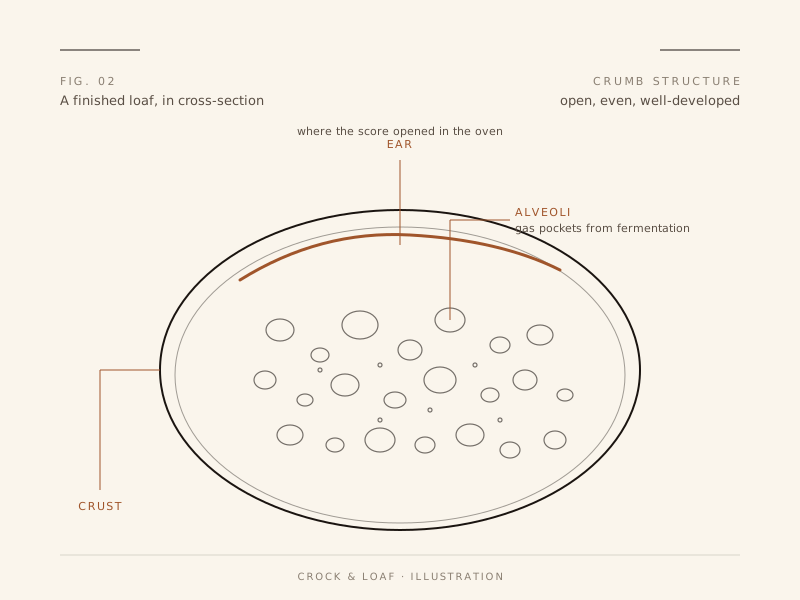
Wooden handle, curved or straight, with a razor blade that swaps out as it dulls. $10–15. Pack of replacement blades runs a few dollars. The cleaner score also produces a more dramatic ear (the lifted edge on top of the loaf) which makes for better-looking bread.
Check on Amazon →What to skip
Items commonly included in starter kits that we'd recommend against buying separately, at least at first:
- Dough scrapers (bench scrapers). Useful for high-hydration doughs, but you can substitute the edge of a metal spatula or even a credit card for the first few months. The premium ones aren't better than the $5 ones.
- Branded printed recipe cards or "starter guides." The information is free and better online.
- Proofing boxes or "bread cloches." Marketing-driven products. An oven with the light on does the job free.
- Decorative jar lids with measurement markings. Doesn't matter what the lid looks like. You're going to take it off twice a day for the life of the starter.
- Pre-mixed starter cultures. Starting a starter from scratch with whole-grain rye and water takes 7 to 14 days. Buying a "100-year-old San Francisco culture" is paying $20 to skip a process that costs $0.50 in flour.
If you're also looking at baking equipment
This article is about starter kit. For the equipment you need to actually bake the bread once your starter is mature, see our dedicated guide on sourdough without a Dutch oven, which covers the three best methods including the Lodge combo cooker we recommend over a traditional Dutch oven.
Related reading
- The best flour for a sourdough starter — Detail on the flour choice that goes with this kit.
- Why is my sourdough starter not rising? — Once you have the kit, the first thing that will probably go wrong.
- Sourdough without a Dutch oven — The baking equipment that comes after the starter is ready.
FAQ
What do you actually need to start sourdough?
A scale, a 1-liter jar with a wide mouth, a flexible spatula or dough whisk, and flour. Everything else (banneton, lame, thermometer, Dutch oven) is helpful but not required for your first weeks. Those four cost about $75 at our recommended picks, or around $35 if you use a budget scale and a mason jar.
Are sourdough starter kits worth it?
The pre-built Amazon kits are not worth it. They cost more than the individual components and almost always include either low-quality versions of items or things you do not need. Assembling six specific items separately costs less and gives you better equipment.
Do I need a banneton for sourdough?
Not strictly. A bowl lined with a heavily floured tea towel works for the first weeks. A real cane banneton produces a slightly better shape and the characteristic ring pattern on the crust, but bread you bake on day one without one is still good bread.
What is the most important piece of equipment for sourdough?
A digital scale. There is no version of getting good at sourdough that doesn't involve weighing ingredients to the gram. Everything else can be improvised. The scale is the only thing that cannot.